Current Projects
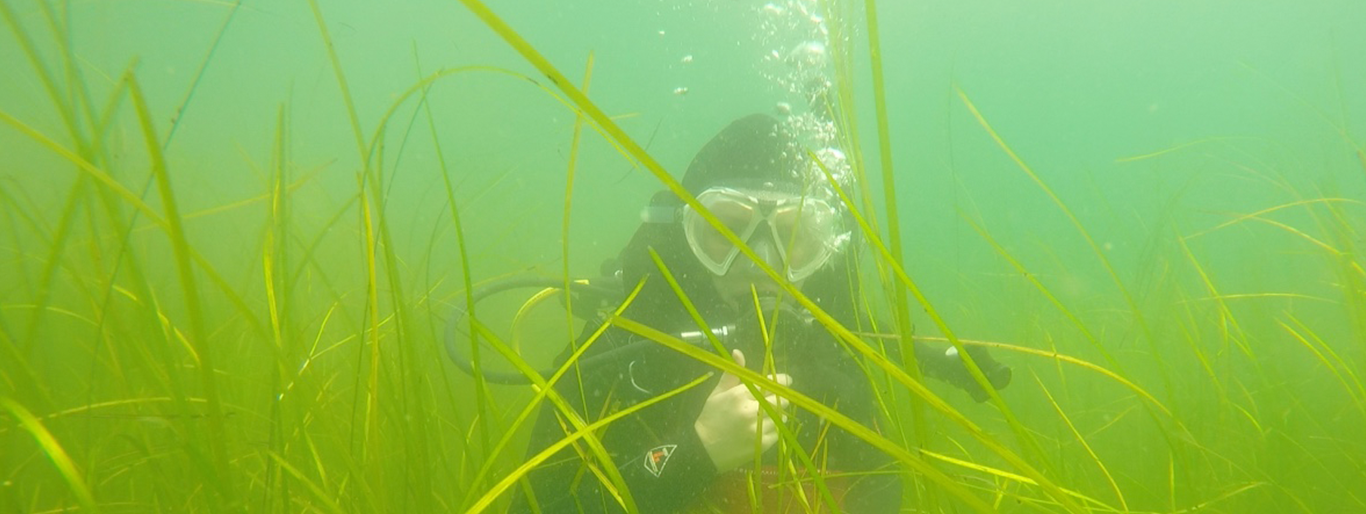
Zostera marina (Eelgrass) is a marine angiosperm, a flowering plant that can be found from the intertidal zone to depths of ~5-6 meters. Eelgrass forms highly productive underwater meadows that sequester carbon, stabilize shorelines, and support a rich and diverse ecological community, including the juveniles of many commercially important fish and invertebrate species. Unfortunately, eelgrass and the valuable ecosystem services that it provides are threatened by multiple stressors linked to coastal development and climate change, so understanding the processes that determine eelgrass distribution and abundance has become an area of great practical concern.
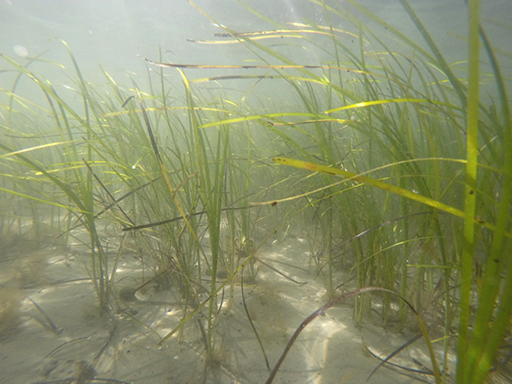
Causes and consequences of genetic diversity in Zostera marina
Experimental work in seagrass systems has shown that more genetically diverse populations are more productive and better able to withstand and recover from environmental disturbances, like temperature extremes and grazing. Like terrestrial grasses, eelgrass reproduces clonally (producing new shoots from underground rhizomes), as well as sexually (via flowers and seeds), and the frequency and success of clonal and sexual reproduction influences the genetic diversity of the larger meadow. We’re working to understand the processes that generate genetic diversity in Zostera marina, and how and why these vary among locations. This includes using microsatellite markers to do ‘paternity tests’ on developing seeds to ask basic questions about pollination in the sea (how far does eelgrass pollen typically disperse? Is there evidence of pollen limitation? Pollen competition?). We are also exploring how spatial patterns of sexual reproductive effort (e.g. percent flowering shoots, number of seeds per shoot) map onto spatial patterns of adult diversity. In those areas where there’s a disconnect (e.g. lots of seeds produced but no recruitment of seedlings), we’re testing possible reasons why – e.g. seed predators or pathogens, hydrodynamic effects (burial or loss), or competition with adults.
Microgeographic differentiation and local adaptation
One of the ways that populations can persist across environmental gradients is via local adaptation, such that individual genotypes possess traits that ‘match’ their local environmental conditions within that gradient. Dispersal and gene flow can counter local selection; thus, over small spatial scales, selection is typically thought to instead favor phenotypic plasticity or ‘generalist genotypes’ with broad physiological tolerances. However, increasing evidence shows that local adaptation can occur over microgeographic scales, suggesting that either selection is stronger, or dispersal more limited, than we often assume.
Preliminary data suggests that Z. marina seeds collected from across the depth gradient may differ in key traits related to timing of germination. The possibility of small-scale local adaptation in Z. marina is particularly interesting because this species represents one of the best-documented examples of the positive ecological effects of genetic diversity (see above), and while local adaption generates/maintains diversity among selective environments, it erodes diversity within them. How the evolutionary processes that create and maintain small-scale genetic diversity in natural Zostera populations interact with those that act to reduce it (e.g., selection) is unclear. With collaborators Dr. Randall Hughes, Dr. Torrance Hanley at NEU, and Dr. Eric Sotka at College of Charleston, and funded by the National Science Foundation, we are testing for local adaptation to depth in Z. marina, and exploring how both negative frequency-dependent selection and directional selection may shape seed/seeding performance across the depth gradient. This work involves using high-throughput genomic techniques along with reciprocal transplant and common garden experiments with seeds in the lab and field.

Maternal effects on demography in intertidal seaweeds
My interests in understanding how species deal with spatial heterogeneity grew out of my dissertation work at UC-Santa Cruz with Dr. Ingrid Parker and Dr. Pete Raimondi, examining dispersal and phenotypic differentiation in the intertidal seaweed Silvetia compressa.
I remain very interested in microgeographic differentiation and maternal effects in intertidal fucoids, and have ongoing side projects with S. compressa to explore how maternal provisioning of eggs may effect progeny performance in different microenvironment. I am also collaborating with Dr. Kylla Benes (Davidson Honors College-UM) to explore similar questions in an East Coast species, Fucus vesiculosus.